
November 3, 2026 | Blog
Toronto Landlords: Could Your Rental Property Be Subject to the Vacant Home Tax?
Your tenant moves out.
You spend a few weeks preparing the unit.
It takes longer than expected to find the next tenant.
A few more months pass.
At what point should a Toronto landlord start thinking about the Vacant Home Tax?
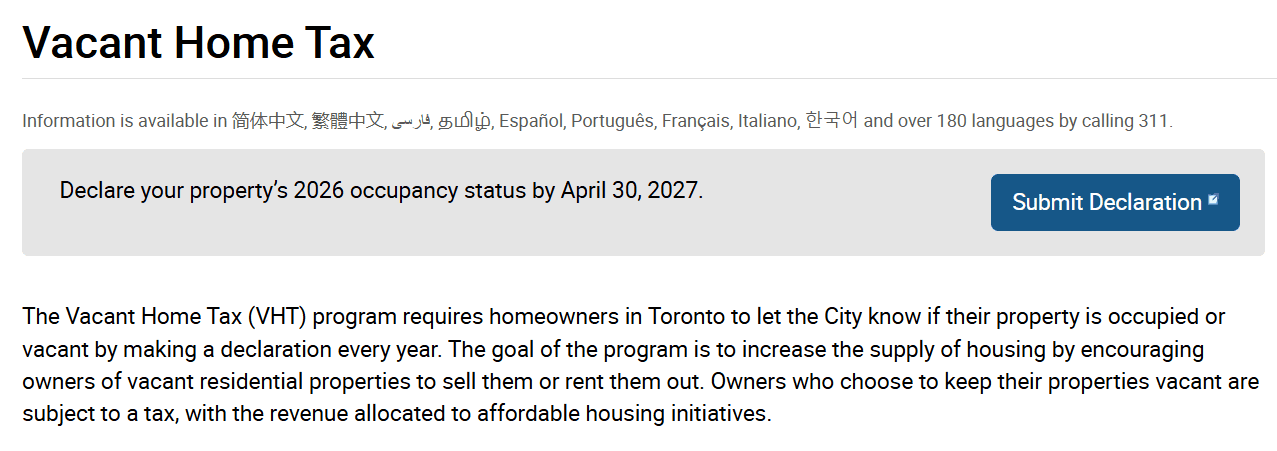
This question is especially relevant now because Toronto officially opened its 2026 Vacant Home Tax declaration period on November 2, 2026.
The declaration deadline is:
April 30, 2027
All Toronto residential property owners generally need to submit a declaration for the 2026 occupancy period — including owners whose properties were rented throughout the year.
And for the 2026 taxation year, Toronto’s Vacant Home Tax rate is:
3% of the property’s Current Value Assessment
as determined by MPAC.
For landlords, however, the important question is not simply:
“Is this an investment property?”
The more important question is:
How was the property actually occupied during the year?
A Rental Property Is Not Automatically Exempt
Owning a rental property does not by itself exempt the unit from Toronto’s Vacant Home Tax.
For a property occupied by a residential tenant, the City currently requires the tenant to have a written agreement for a term of at least 30 days, with total tenant occupancy of at least six months during the year.
Those six months can be based on qualifying tenant occupancy in aggregate during the year.
So if you own a Toronto condo that was rented throughout most of 2026, the property would generally not be considered vacant simply because you do not personally live there.
But if the property spent a significant part of the year between tenants, under renovation or otherwise unoccupied, the occupancy timeline becomes much more important.
Example: Your Tenant Moves Out and the Unit Takes Months to Re-Rent
Imagine this situation.
Your tenant moves out at the end of February.
You spend March preparing the property.
You list it for rent in April.
The market is slower than expected.
A new tenant finally moves in during August.
A landlord might think:
“The property was available for rent, so it wasn’t really vacant.”
But listing a property for rent is not necessarily the same as the property being occupied for VHT purposes.
The City looks at the property’s actual occupancy status.
If qualifying tenant occupancy does not reach the required period during the year, you need to look much more carefully at whether the property could meet the definition of vacant or whether an exemption applies.
This is why landlords should pay attention to the entire year’s timeline, not just whether the unit was eventually rented.
Tenant Turnover Can Matter More Than You Think
A normal gap between two tenants does not automatically create a Vacant Home Tax bill.
For example:
Tenant A: January–May
Vacant: June–July
Tenant B: August–December
There is substantial tenant occupancy during the year.
Compare that with:
Tenant A: January–February
Vacant: March–August
Tenant B: September–December
Now the property’s occupancy history looks very different.
The City’s rules focus on whether the property was occupied for the required amount of time and whether any applicable exemption applies.
For landlords with several move-ins and move-outs during a year, maintaining an accurate occupancy timeline becomes especially important.
“But I Was Renovating the “Unit”—Does That Make It Exempt?
Possibly, but not automatically.
Toronto has an exemption for certain major repairs or renovations.
However, the City’s current criteria include requirements such as:
- The work must prevent normal occupation and use of the property for at least six months of the taxation year
- Required permits must have been issued
- The work must be actively carried out without unnecessary delay
- Supporting documentation may be required
So a landlord generally should not assume that:
“I renovated between tenants, so those vacant months don’t count.”
Painting the unit, replacing flooring, updating appliances or doing a short turnover renovation may not meet the City’s exemption criteria.
The exact circumstances matter.
What About a Newly Closed Condo That Hasn’t Been Rented Yet?
This is another situation Toronto landlords should pay attention to.
Suppose you close on a new condo and plan to rent it out.
But because of:
- deficiencies;
- furnishing;
- developer issues;
- market conditions;
- or difficulty finding a suitable tenant,
the unit remains empty for an extended period.
Do not assume that being a newly purchased investment automatically means the property is exempt.
Toronto does have a Transfer of Legal Ownership exemption when a qualifying 100% ownership transfer closes during the taxation year being declared. The City also has a separate vacant-new-inventory exemption for qualifying developer-owned units, but that exemption is aimed at developers and has its own conditions.
For an individual investor, the property’s closing date, ownership status and actual occupancy history all matter.
What If a Family Member or Friend Is Living There?
This is another area where landlords can misunderstand the rules.
Toronto allows occupancy by someone other than the owner, which may include:
- Residential tenants
- Business tenants
- Family members
- Friends
But the rules are different depending on who occupies the property.
For tenants, the City looks for a qualifying written agreement and sufficient total occupancy during the year.
For family members or friends, the property generally needs to be their principal residence for at least six months of the year to claim occupied status.
So simply saying:
“Someone stayed there occasionally”
is not necessarily enough.
Landlords Should Keep More Than Just the Lease
Good record-keeping becomes important if the City later asks you to support your declaration.
Examples of documentation the City may request include:
- Lease agreements
- Tenant insurance documentation
- Government-issued identification showing the address
- Tax documents showing the address
- Employment records
- Other documentation supporting occupancy
The City currently requires owners to retain records relating to occupancy or a claimed exemption for at least three years.
From a property-management perspective, landlords should also keep an organized record of:
- Tenant move-in date
- Tenant move-out date
- Lease term
- Vacancy periods
- Rental listing dates
- Repair and renovation dates
- Invoices and contractor records
- Building permits, where applicable
- VHT declaration confirmation
That makes it much easier to reconstruct what actually happened at the property if questions arise later.
One Property? Multiple Properties? Each One Matters
If you own several Toronto properties, you cannot simply make one declaration covering your entire portfolio.
The City states that owners of multiple residential properties must submit a separate declaration for each applicable property.
Individual condominium units also need to be considered separately.
For landlords with multiple units, this is another reason to maintain a clear annual record for every property.
What Happens If You Forget to Declare?
Even if your rental property was properly occupied all year, failing to submit the declaration can still create a problem.
If the City does not receive the required declaration by the deadline, the property may be deemed vacant and a Vacant Home Tax assessment may be issued.
For the 2026 occupancy year, the deadline is:
April 30, 2027
Owners can dispute certain assessments through the City’s Notice of Complaint process, but preventing the issue in the first place is much easier.
A Simple Annual Checklist for Toronto Landlords
When reviewing your rental property for the 2026 declaration, ask:
- Was the property occupied by qualifying tenants for at least six months?
- Were there long gaps between tenants?
- When exactly did each tenant move in and move out?
- Was the property undergoing renovations?
- Would those renovations actually meet the City’s exemption requirements?
- Did ownership change during the year?
- Do I have documentation supporting the occupancy status I am declaring?
- Have I saved my VHT confirmation?
If you cannot quickly answer these questions, your property records may need some attention.
Why This Matters Beyond the Vacant Home Tax
The VHT is one example of why good property management is about more than:
collecting rent and arranging repairs.
A properly managed rental should also have clear records showing:
- who occupied the property;
- when they moved in;
- when they moved out;
- which lease applied;
- when maintenance or renovation work occurred;
- and what happened during periods when the property was vacant.
These records can become useful for much more than VHT.
They can also help when dealing with:
- tenant disputes;
- insurance questions;
- maintenance history;
- future leasing;
- property sales;
- and other administrative issues.
Topromanage Perspective
For Toronto landlords, the most important takeaway is simple:
Do not assume that “it’s a rental property” means the Vacant Home Tax cannot apply.
Look at the actual occupancy timeline.
A short vacancy between tenants may not create a problem.
But multiple vacancies, a long turnover period or a property that remains unrented for a significant portion of the year deserves a closer look.
And if you are claiming an exemption:
make sure the situation actually meets the City’s criteria and keep the supporting records.
Is Your Toronto Rental Sitting Vacant?
If your tenant has moved out, your unit has been sitting on the rental market, or you’re preparing a newly closed property for its first tenant, reducing unnecessary vacancy should be part of your property strategy.
ToproManage assists landlords with:
- Rental marketing
- Tenant placement
- Lease and tenancy administration
- Move-in and move-out coordination
- Property inspections
- Maintenance coordination
- Ongoing property management
- Organized property and tenancy records
Good management cannot guarantee that a property will never be vacant.
But having an organized leasing process and clear property records can make it much easier to understand what is happening with your investment throughout the year.
Source: City of Toronto

The Topromanage Experience
Discover decades of industry expertise that covers all of the GTA and Southern Ontario.

Scan A QR Code to Connect With Us
WeChat
WhatsApp