
August 31, 2026 | Blog
Ontario Landlord Raised the Rent by More Than 50% — Then the LTB Found a Fundamental Problem
Imagine you own a rental property where operating costs have increased significantly.
The existing rent is far below what comparable units are charging, and financially, you believe the rent needs to go up.
So you notify the tenant of a substantial increase.
The tenant refuses to pay the new amount.
You treat the difference as rent arrears and eventually take the matter to the Landlord and Tenant Board.
But when the case reaches the LTB, the issue isn’t simply:
“Was the higher rent reasonable?”
Instead, a much more fundamental question arises:
Was the rent increase legally valid in the first place?
A recent Windsor case involving a 91-year-old tenant provides an important reminder for Ontario landlords:
Having a financial reason to increase rent and having the legal right to increase rent are two different things.
What Happened in the Windsor Case?
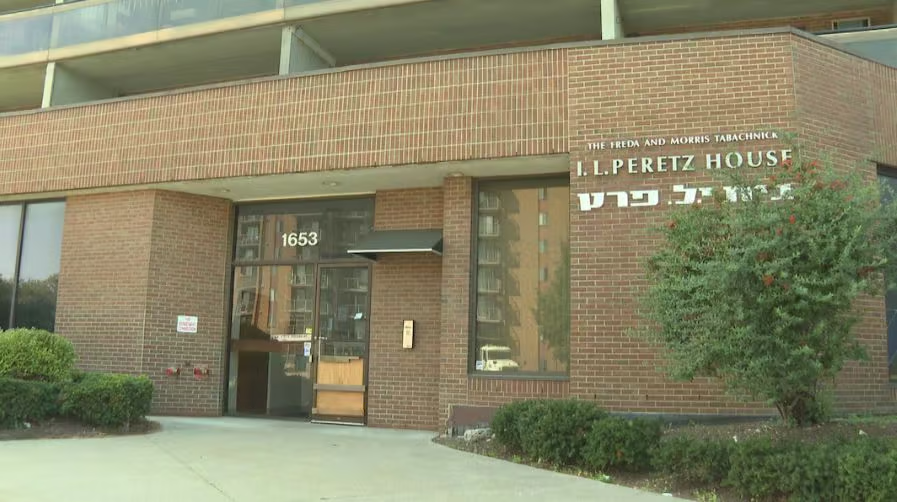
According to recent reporting, Sylvia Berk, a 91-year-old resident of I.L. Peretz House in downtown Windsor, had lived in the seniors’ apartment building for more than a decade.
The landlord is a non-profit organization affiliated with the Windsor Jewish Federation.
Berk had reportedly been paying approximately $450 per month, with subsidies helping keep her rent low.
She was later informed that her rent would increase to approximately:
$700 per month.
That represented an increase of more than 50%.
Berk continued paying the previous amount, and the landlord eventually served an eviction notice based on the resulting alleged rent arrears.
The dispute went before Ontario’s Landlord and Tenant Board.
The LTB ultimately found a fundamental problem with the landlord’s position in Berk’s case, including the basis on which the landlord claimed the tenancy was exempt from ordinary rent-increase restrictions. The eviction notice was found defective.
The dispute is particularly complicated because this was non-profit/community housing, where rent rules can differ from ordinary private-market rentals.
And that distinction is extremely important.
This case does NOT mean every Ontario landlord is prohibited from substantially increasing rent.
But it does provide a valuable lesson about what landlords should check before changing the rent.
Lesson #1: Before Increasing Rent, Know Which Rules Apply to Your Unit
This sounds obvious.
In practice, it’s where many problems begin.
Ontario does not have one identical rent-increase rule for every rental property.
For most rent-controlled private residential units, Ontario sets an annual rent increase guideline.
For 2026, that guideline is 2.1%.
For 2027, it will be 1.9%.
But there are important exceptions.
For example, the provincial guideline generally does not apply to certain units first occupied for residential purposes after November 15, 2018. Community housing also operates under different rent-control and rent-increase-notice rules.
So before calculating any increase, the first question shouldn’t be:
“How much more should I charge?”
It should be:
“What rent-increase rules actually apply to this property?”
Rent-Controlled vs. Rent-Control-Exempt: Don’t Guess
This distinction is especially important for GTA landlords.
Suppose you’re renting a condo for $2,500 per month.
You discover similar units are now renting for $2,900.
Can you simply increase your tenant’s rent to $2,900?
Maybe — but maybe not.
If the unit is subject to Ontario’s rent increase guideline, you generally cannot simply bring an existing tenant’s rent up to market rent because surrounding rents have increased.
For 2026, the guideline for most covered units is 2.1%, unless another lawful mechanism applies.
But if the unit qualifies for an exemption from the guideline—for example, certain units first occupied for residential purposes after November 15, 2018—the situation can be different.
Even then:
“Not subject to the guideline” does not mean “there are no rules.”
Other requirements still matter.
Lesson #2: Even a Rent-Control-Exempt Unit Still Requires Proper Notice
This is one of the most useful things Ontario landlords should understand.
Some landlords hear:
“My condo was built after 2018, so it’s not rent controlled.”
And interpret that as:
“I can increase the rent whenever I want.”
That’s incorrect.
Ontario’s rules generally require at least 12 months to have passed since the tenant’s tenancy began or since the tenant’s last rent increase before another lawful increase can take effect.
The landlord must also generally provide:
at least 90 days’ written notice
using the proper LTB notice form.
So even where the annual guideline does not limit the amount, timing and notice requirements still matter.
Lesson #3: “I Sent the Tenant an Email” May Not Be Enough
Imagine a landlord sends this message:
Starting next month, your rent will increase from $2,500 to $2,700.
The tenant replies:
OK.
Is everything necessarily done correctly?
Don’t assume so.
Ontario’s Residential Tenancies Act requires the landlord to provide the required notice of rent increase, and the notice must be in a form approved by the LTB. The Act also states that a rent increase is void if the required notice has not been given.
For many ordinary rent increases, landlords will encounter the N1 Notice of Rent Increase. The N1 instructions specifically state that the landlord must provide the tenant with at least 90 days’ notice.
The appropriate form depends on the type of tenancy and increase.
The lesson is simple:
Don’t improvise a rent increase notice.
Check which form and rules actually apply.
Lesson #4: Market Rent Does Not Automatically Determine an Existing Tenant’s Rent
This is another extremely common misunderstanding.
Suppose your tenant has lived in your Markham condo since 2019.
They’re paying:
$2,200/month.
A new tenant renting the same floor plan today might pay:
$2,800/month.
The landlord sees the $600 difference and thinks:
“I’m losing $7,200 every year.”
Financially, that’s understandable.
Legally, however, the fact that your tenant is paying below-market rent does not automatically allow you to increase their rent to market level.
For a tenancy subject to the guideline, Ontario generally limits annual increases unless a lawful exception or LTB-approved increase applies.
Market rent and lawful rent are not necessarily the same number.
That distinction becomes especially important in long-term tenancies.
Lesson #5: Higher Operating Costs Don’t Automatically Let You Pick a Higher Rent
Landlords are dealing with very real cost increases.
Property taxes can rise.
Condo maintenance fees can rise.
Insurance premiums can increase.
Contractor and maintenance costs can increase.
Utilities may become more expensive.
Mortgage payments can increase dramatically at renewal.
From a landlord’s perspective, it may seem completely reasonable to say:
“My expenses increased $500 per month, so I need to raise the rent $500.”
But Ontario rent law doesn’t work that way for a rent-controlled tenancy.
A landlord cannot simply calculate their increased expenses and pass the entire amount directly to the tenant.
There are circumstances where a landlord may seek an Above Guideline Increase (AGI) through the LTB—for example, certain qualifying extraordinary municipal tax increases, eligible capital expenditures or security-service costs—but that is a specific legal process with its own requirements.
Higher expenses alone don’t give a landlord unlimited authority to set a new rent.
What Is an Above Guideline Increase?
An Above Guideline Increase is exactly what the name suggests.
In qualifying circumstances, a landlord can apply to the LTB for permission to increase rent by more than the normal annual guideline.
But an AGI isn’t simply:
“My mortgage got expensive, so I want another 5%.”
The legislation and regulations specify the types of expenses that can qualify and how the increase is calculated.
This is why landlords considering a significant increase should understand the difference between:
a normal annual rent increase
and
an LTB-approved Above Guideline Increase.
They are not interchangeable.
Lesson #6: If the Increase Is Invalid, the “Arrears” Calculation May Also Be Wrong
This is where a rent-increase mistake can become much bigger.
Consider a simplified example.
The tenant’s existing lawful rent is:
$1,500.
The landlord tells the tenant the new rent is:
$1,800.
The tenant continues paying $1,500.
After six months, the landlord calculates:
$300 × 6 = $1,800 in arrears.
But what happens if the $300 increase itself was never legally valid?
Then the landlord may have a serious problem with the arrears calculation.
The Residential Tenancies Act specifically provides that a rent increase is void where the required notice wasn’t given.
So before treating a tenant’s refusal to pay an increase as:
“non-payment of rent,”
make sure the increased amount actually became the lawful rent.
This Is Why the Windsor Case Matters to Ordinary Landlords
The Windsor dispute involves circumstances that are different from a typical privately owned Toronto condo or GTA rental house.
It’s a seniors’ building operated by a non-profit organization, and Ontario specifically notes that social/community housing can be subject to different rent rules.
So landlords shouldn’t read the headline and conclude:
“The LTB says landlords can never raise low rents substantially.”
That’s not the lesson.
The better lesson is:
Before relying on an exemption or special rent rule, make sure your property actually qualifies for it.
Because if your legal assumption is wrong, everything that follows may also become problematic.
A Common GTA Example: The New Condo
Here’s a much more typical scenario.
A landlord buys a newer Toronto condo.
The unit was first occupied for residential purposes after November 15, 2018.
The landlord has heard that newer units can be exempt from Ontario’s annual rent increase guideline.
That’s potentially correct.
But the landlord should still verify and retain evidence supporting the exemption.
Ontario specifically recommends keeping records such as:
- building permits
- occupancy permits
- new-home warranty documents
- builder documentation
because if a dispute occurs, the landlord may need to prove when the building or unit was first occupied.
This is particularly important when buying an investment property from another owner.
Don’t simply assume:
“The listing agent said it’s not rent controlled.”
Keep evidence.
Another Common Mistake: Confusing a New Tenant With an Existing Tenant
Suppose your existing tenant moves out.
You find a completely new tenant.
That’s different from increasing the rent during an existing tenancy.
Ontario’s rent increase guideline generally does not apply to the rent negotiated upon turnover to a new tenant.
So if the previous tenant paid:
$2,100
and today’s market rent is:
$2,700,
the landlord and a new tenant can generally agree to a new starting rent of $2,700, subject to the applicable law.
But while the existing tenancy continues, the landlord cannot simply say:
“The market is $2,700 now, so starting next month that’s your rent.”
These are two completely different situations.
What Should a Landlord Check Before Increasing Rent?
Before sending anything to the tenant, verify five things.
1. When was the unit first occupied for residential purposes?
This may determine whether the annual guideline applies.
2. When did this tenant’s tenancy begin?
The 12-month timing rule matters.
3. When was the last rent increase?
You generally cannot increase rent repeatedly within the same 12-month period.
4. Which notice form applies?
Don’t create your own informal notice because it seems easier.
5. How much can you legally increase the rent?
For most guideline-covered units, the 2026 guideline is 2.1%. For increases taking effect in 2027, the guideline is 1.9%.
Only after answering these questions should you calculate the new rent and prepare the notice.
A Simple Example
Suppose a tenant in Richmond Hill currently pays:
$2,500/month.
The unit is covered by the rent increase guideline.
The landlord hasn’t increased the rent in more than 12 months.
For an increase taking effect in 2026, the guideline is 2.1%.
A simple guideline calculation would be:
$2,500 × 2.1% = $52.50
New monthly rent:
$2,552.50
The landlord would still need to provide the required notice at least 90 days before the increase takes effect.
The fact that similar properties nearby rent for $2,900 doesn’t automatically change that calculation.
What If the Tenant Says, “I’m Not Paying the Increase”?
Don’t immediately assume the tenant is simply refusing to pay rent.
First verify:
Was the increase lawful?
If yes, document the notice, effective date, lawful rent and payments carefully.
If not, serving further notices based on an incorrect rent amount can create additional complications.
The Windsor case demonstrates why getting the first step right matters so much.
A mistake in the rent increase can potentially affect what you later describe as:
rent arrears.
Final Thoughts
The Windsor case is unusual, but the lesson for Ontario landlords is extremely practical.
Before increasing rent, don’t start with:
“How much more can the market support?”
Start with:
“What is the lawful rent, and which rules apply to this tenancy?”
For landlords in Toronto, Markham, Richmond Hill, Vaughan, Mississauga and across the GTA, this is especially important because the rental market contains a mix of:
older rent-controlled properties,
newer guideline-exempt properties,
condominiums,
houses,
secondary suites,
and other types of rental housing.
Two properties on the same street may not necessarily be subject to exactly the same rent-increase restrictions.
At Topromanage, we believe rent increases should be treated as a process—not simply a number.
Check the property.
Check the tenancy.
Check the timing.
Use the appropriate notice.
Keep proof.
Because if the rent increase itself isn’t valid, the problems that follow can become much more complicated than the extra rent you were trying to collect.
Source: CBC

The Topromanage Experience
Discover decades of industry expertise that covers all of the GTA and Southern Ontario.



Scan A QR Code to Connect With Us
WeChat
WhatsApp