
August 20, 2026 | Blog
Major Ontario Landlord-Tenant Changes Take Effect September 21: What Landlords and Tenants Need to Know
Ontario’s rental rules are changing again.
Beginning September 21, 2026, several important amendments affecting rent arrears and landlord’s-own-use evictions are expected to take effect.
For landlords, the changes could speed up certain parts of the eviction process and reduce compensation requirements in some N12 situations.
For tenants, however, the timelines will become much tighter—and the rules around landlord’s-own-use evictions will continue to require genuine, documented intent.
The biggest changes include:
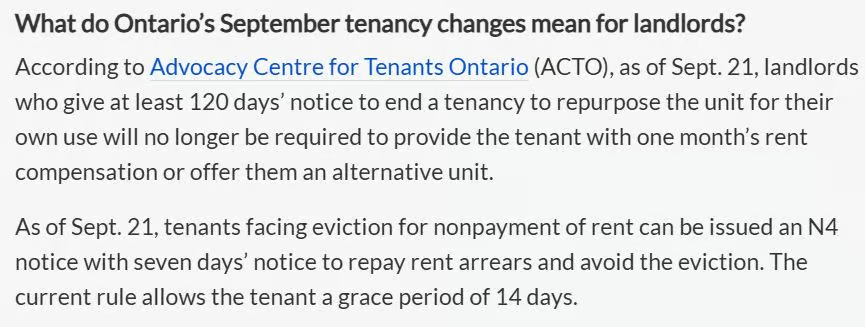
- The N4 termination period for unpaid rent will be shortened from 14 days to 7 days
- Some landlords using an N12 for personal use will no longer need to provide one month’s rent compensation if they give at least 120 days’ notice
- New rules will place greater attention on whether the person named in an N12 actually moves into the rental unit as required
Tribunals Ontario has confirmed that amendments introduced through Ontario’s Fighting Delays, Building Faster Act, 2025 (Bill 60) are being implemented in stages, with additional Residential Tenancies Act changes scheduled to take effect in September 2026.
Here is what landlords and tenants should understand before September 21.
N4 Rent-Arrears Timeline Will Drop From 14 Days to 7 Days
One of the most significant changes involves unpaid rent.
Currently, when a monthly tenant fails to pay rent, a landlord can generally serve an N4 Notice to End a Tenancy Early for Non-payment of Rent, with a termination date at least 14 days after the notice is given.
Under the new legislation, that minimum period will be reduced to:
7 days
Bill 60 specifically amends Ontario’s Residential Tenancies Act so that a landlord may give a non-payment notice with a termination date no earlier than the seventh day after the notice is given.
That effectively cuts the current timeline in half.
What Does the 7-Day N4 Rule Actually Mean?
It does not mean that a tenant is automatically evicted after seven days.
That distinction is important.
An N4 is a notice—not an eviction order.
If the tenant pays the required rent arrears within the applicable period, the notice may be voided according to the applicable rules.
If the arrears are not resolved, the landlord can then move forward through the Landlord and Tenant Board process where permitted.
So the basic process remains:
Rent unpaid → N4 served → 7-day termination period → arrears unresolved → landlord may proceed with the next LTB step
The major difference is that everything begins moving sooner.
For tenants, this means there will be much less time to arrange payment after receiving an N4.
For landlords, it means late-rent problems will require even more accurate recordkeeping because dates and amounts will become particularly important.
A Simple Example
Suppose monthly rent is due on October 1.
The tenant does not pay.
The landlord properly serves an N4.
Under the current system, the termination period for a monthly tenancy generally gives the tenant significantly more time before the stated termination date.
Under the September changes, the legislation permits the N4 termination date to be as early as the seventh day after the notice is given.
That makes it even more important for landlords to ensure:
- The rent amount is correct
- Any previous payments are properly recorded
- The notice is completed correctly
- Service of the notice can be documented
- The landlord does not move to the next stage too early
A faster timeline does not make incorrect paperwork acceptable.
Landlord’s Own Use: The 120-Day N12 Change
The second major change involves N12 landlord’s-own-use evictions.
An N12 can be used in qualifying circumstances where the landlord, certain family members, a caregiver, or another person permitted under the Residential Tenancies Act genuinely intends to occupy the rental unit.
Under the existing system, landlords using this process generally have to provide the tenant with compensation equal to one month’s rent or offer another acceptable rental unit.
Beginning with the new rules, that compensation requirement will not apply in certain situations where the landlord provides significantly more notice.
Bill 60 states that the compensation or replacement-unit requirement does not apply where the qualifying N12 notice:
- Is given after the new provision comes into force
- Provides a termination date at least 120 days after the notice
- Uses a termination date that falls at the end of the applicable rental period or fixed term
For qualifying landlords, that can reduce the direct cost of an own-use termination.
60 Days or 120 Days: Why the Difference Matters
This change creates an important planning decision for landlords.
In broad terms, a landlord considering a qualifying own-use termination may face different requirements depending on the amount of notice provided.
Giving the longer 120-day notice can remove the one-month compensation requirement where the new statutory criteria are satisfied.
But that does not mean every N12 should automatically be issued 120 days in advance.
The correct termination date still needs to comply with the tenancy and applicable legislation.
Landlords should look at:
- Whether the tenancy is month-to-month or fixed-term
- When the current lease term ends
- Who is actually moving into the property
- When that person realistically intends to occupy it
- Whether the longer notice period fits the landlord’s plans
The main takeaway is simple:
More advance notice may reduce compensation, but the N12 still has to be genuine and properly completed.
No Compensation Does Not Mean N12 Becomes Easier to Abuse
This is probably the most important point in the entire update.
Some landlords may hear:
“120 days’ notice means I don’t have to pay one month’s rent.”
and assume N12 has suddenly become an easier eviction tool.
That would be a serious misunderstanding.
An N12 is not designed to remove a tenant simply because:
- The landlord wants higher rent
- The current tenant is paying below market
- The landlord wants a different tenant
- The property would be easier to sell vacant
- The landlord has changed their investment strategy
The own-use intention still has to be genuine.
The reduction in compensation requirements does not remove the requirement for good faith.
The Person Named on the N12 Must Actually Move In
The September changes also increase the importance of what happens after an N12 termination.
According to the newly reported rules, the person identified as intending to occupy the rental unit will be expected to actually move into the property within the prescribed timeframe, including a 60-day period referenced in current reporting on the September reforms.
Failure to do so may create a presumption that the original N12 was issued in bad faith, potentially requiring the landlord to prove that the original own-use intention was genuine.
Tribunals Ontario has confirmed that further Bill 60 and Bill 97 amendments are scheduled for September and that updated information and forms will be provided as implementation proceeds.
Landlords should therefore watch for the final updated N12 instructions and LTB materials before using the new process.
Why the Move-In Requirement Matters
Imagine a landlord serves an N12 stating that they intend to move into the unit.
The tenant moves out.
But two months later, the property is advertised for rent again at a substantially higher price.
That is exactly the type of situation that can raise questions about whether the original N12 was genuinely issued for personal use.
Ontario already provides tenants with remedies where an N12 is found to have been given in bad faith. Current LTB materials show that remedies in bad-faith termination cases can include substantial compensation, including general compensation of up to the equivalent of 12 months of the tenant’s former rent in qualifying cases.
So although one part of the new law may reduce an upfront cost for landlords, misuse of the N12 process can still become extremely expensive.
What Should Landlords Do Before Serving an N12?
The most important thing is to plan before sending the notice.
First, confirm exactly who will occupy the property.
Second, make sure that person genuinely intends to live there.
Third, work backwards from the intended move-in date and determine the correct termination date.
Fourth, decide whether the 120-day compensation exemption is actually available and appropriate for the tenancy.
Finally, keep documentation that supports the genuine plan to occupy the property.
This could become important if the N12 is later challenged.
The goal should never be:
How do I get the tenant out as cheaply as possible?
The better question is:
Is this genuinely an own-use situation, and am I following the correct process?
What Should Landlords Do About Rent Arrears After September 21?
The shortened N4 timeline also means landlords need to improve their rent-management process.
When rent is missed:
Confirm the amount immediately
Check whether any partial payment, bank transfer, credit or previous balance affects the amount owing.
Communicate early
A quick message may sometimes identify a simple payment issue before it becomes a formal dispute.
Keep accurate records
Keep rent ledgers, payment confirmations and communication.
Use the correct N4
Do not improvise your own eviction notice.
Pay attention to dates
With the new seven-day period, mistakes can happen quickly if notices are prepared carelessly.
Follow the LTB process
The expiry of an N4 does not give a landlord the right to change locks or remove the tenant personally.
The Landlord and Tenant Board remains responsible for resolving residential tenancy disputes and eviction applications under Ontario’s Residential Tenancies Act.
What Do These Changes Mean for Tenants?
For tenants, the biggest change is speed.
If rent is missed and an N4 is served after the new rules take effect, the time available before the termination date will be significantly shorter.
That means tenants should not ignore an N4 or wait until the last minute to understand the amount owing.
The N12 changes are different.
A tenant receiving an own-use notice should look carefully at:
- Who is supposed to move in
- The stated termination date
- How much notice was given
- Whether compensation applies
- Whether the person named actually occupies the property afterward
The new compensation exemption does not eliminate protections against bad-faith own-use evictions.
Why These Changes Matter for Ontario Rental Property Management
Taken together, the September changes point in an interesting direction.
For rent arrears, the system is becoming faster.
For qualifying N12 cases, landlords who provide substantially more notice may face lower upfront compensation costs.
But at the same time, own-use evictions are becoming increasingly focused on whether the landlord’s stated intention is actually carried out.
For property owners, that means the rules may become faster in some areas—but documentation and compliance will matter even more.
A shorter deadline does not help if the N4 contains the wrong rent amount.
A 120-day N12 does not help if the supposed occupant never genuinely moves in.
Final Thoughts
Starting September 21, 2026, Ontario landlords and tenants will need to adjust to several significant changes.
For unpaid rent, the N4 termination period will be shortened from 14 days to 7 days, meaning arrears situations can begin moving through the process much faster. Bill 60 expressly changes the legislation to permit a termination date no earlier than the seventh day after notice is given.
For landlord’s-own-use terminations, qualifying landlords who provide at least 120 days’ notice may no longer be required to provide one month’s rent compensation or an alternative rental unit, provided the statutory requirements are met.
But landlords should not interpret these changes as permission to become less careful.
The opposite is true.
With tighter timelines and greater scrutiny of genuine own-use intentions, proper notices, accurate dates, clear documentation and good-faith decision-making will become even more important.
At Topromanage, we believe good property management starts with understanding the rules before a problem occurs.
Whether the issue is rent arrears, an N12, tenant communication or preparing the correct documentation, handling the process properly from the beginning can prevent a relatively manageable situation from becoming a costly LTB dispute.
Related Topromanage Guides:
N13 Changes September 21, 2026 guide for the renovation-related rules Ontario Persistent Late Rent Rule September-21

The Topromanage Experience
Discover decades of industry expertise that covers all of the GTA and Southern Ontario.



Scan A QR Code to Connect With Us
WeChat
WhatsApp