
September 8, 2026 | Blog
Your Tenant’s Rent Could Automatically Go Down — What Toronto Landlords Need to Know Before September 15
Most Ontario landlords know that there are rules governing rent increases.
But far fewer realize that, under certain circumstances, a tenant’s lawful rent can also automatically decrease.
And the landlord does not necessarily get to decide whether to accept it.
Under section 131 of Ontario’s Residential Tenancies Act (RTA), if the municipal property tax on a residential complex decreases by more than 2.49% from one year to the next, the lawful rent for the rental units may be automatically reduced according to a prescribed formula.
For Toronto landlords, this topic is particularly timely.
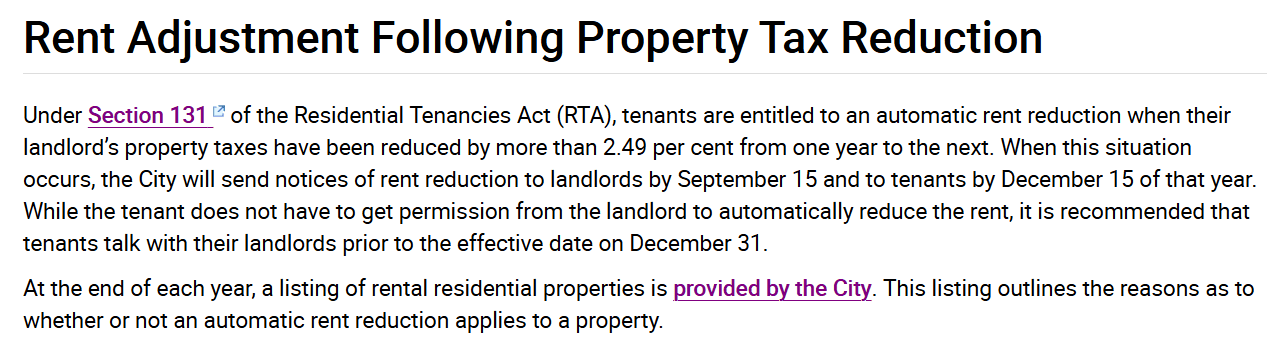
The City of Toronto says that, when an automatic rent reduction applies, notices are sent to affected landlords by September 15 and to tenants by December 15. The reduction takes effect on December 31.
So if you’re a Toronto landlord and a Notice of Rent Reduction arrives this fall, don’t assume it’s a mistake.
Here’s what you need to know.
Quick Answer: Why Can a Tenant’s Rent Automatically Decrease?
Ontario law connects a portion of residential rent to municipal property taxes.
If the property tax for a residential complex decreases by more than 2.49% compared with the previous year, section 131 of the Residential Tenancies Act can trigger an automatic reduction in the lawful rent.
But this does not mean:
Property taxes dropped 5%, so rent automatically drops 5%.
The actual rent reduction is much smaller because Ontario uses a prescribed formula.
For many residential-class properties, only 15% of the percentage decrease in property tax is used to calculate the percentage rent reduction.
What Is Ontario’s Automatic Rent Reduction Rule?
Ontario Regulation 516/06 sets the threshold at:
More than 2.49%
If municipal property tax decreases beyond that threshold between two consecutive years, the rent reduction is calculated according to provincial rules.
For the purpose of this rule, the regulation defines municipal property tax in a specific way. Certain municipal charges, penalties, interest, emergency repair charges and other costs are not necessarily included in the calculation.
So landlords should not simply compare every amount appearing on two property-tax bills and assume they already know the result.
September 15 Matters for Toronto Landlords
The provincial regulation provides a notification period of:
June 1 to September 15 for landlords
and:
October 1 to December 15 for tenants.
The City of Toronto summarizes this by advising that applicable notices are sent to landlords by September 15 and tenants by December 15.
That means September is a good time for rental property owners to pay closer attention to mail related to:
- Property taxes
- Municipal notices
- Rent reductions
- Rental property records
Don’t assume a City notice is simply another property-tax statement.
Read it carefully.
Which Rental Properties Can Be Affected?
This rule is not limited to large apartment buildings.
The City of Toronto specifically lists a wide range of rental properties that can potentially be subject to automatic rent reductions, including:
- Apartment buildings
- Rented townhouses
- Duplexes
- Detached houses
- Rented condominiums
- Rooming, boarding and lodging houses
- Mobile-home parks and land-lease communities
- Most private care homes
- Certain for-profit co-operatives
Toronto also lists several categories where automatic rent reduction does not apply, including certain public housing, non-profit housing, non-profit co-operatives, vacation homes, nursing homes and commercial or industrial properties.
So yes:
Even an individual landlord renting out a condo, townhouse or detached house should understand this rule.
Does Every Property Tax Decrease Automatically Reduce Rent?
No.
The automatic reduction under section 131 is triggered when the municipal property tax decreases by:
more than 2.49%.
If the decrease is exactly 2.49% or less, the automatic mechanism is not triggered.
However, the City of Toronto notes that a tenant whose building experienced a tax decrease of 2.49% or less may still apply to the Landlord and Tenant Board for a rent reduction.
That is an important distinction:
Automatic reduction and tenant application for a reduction are not necessarily the same process.
How Is the Rent Reduction Calculated?
This is where many landlords and tenants misunderstand the rule.
Suppose your property taxes decreased by:
8%
That does not mean the tenant’s rent drops by 8%.
Ontario’s regulation says the property-tax decrease percentage is multiplied by:
20%
for properties in the multi-residential property tax class,
or:
15%
for properties outside that class under the applicable formula.
So for a typical residential-class rental property:
8% property-tax decrease × 15% = 1.2% rent reduction
The rent decreases by 1.2%, not 8%.
Example: What Would the Rent Actually Become?
Imagine a Toronto landlord rents a condominium for:
$2,500 per month
Assume the property’s qualifying municipal property tax decreased by:
8%
If the 15% factor applies:
8% × 15% = 1.2%
The rent reduction is therefore:
$2,500 × 1.2% = $30
The new lawful monthly rent would become:
$2,470
Not:
$2,300.
The City of Toronto specifically cautions that the percentage decrease in property tax is not the same as the percentage decrease in rent.
When Does the Lower Rent Take Effect?
The prescribed effective date is:
December 31
of the year in which the relevant property-tax reduction takes effect.
The important point for landlords is that the reduction does not depend on the landlord choosing to approve it.
Section 131 says the reduction takes effect on the prescribed date whether or not notice was given in circumstances where the statutory reduction applies.
That makes it particularly important for landlords to understand their property’s lawful rent rather than relying only on the amount they have historically collected.
Does the Tenant Need the Landlord’s Permission?
No.
The City of Toronto specifically states that a tenant does not have to obtain the landlord’s permission to take an applicable automatic rent reduction.
The City does recommend that tenants communicate with landlords before the December 31 effective date.
For landlords, this is important.
If a valid automatic rent reduction applies, responding with:
“I never agreed to lower your rent.”
does not necessarily solve the issue.
The first question should instead be:
Does the statutory reduction apply, and was the amount calculated correctly?
What If the Landlord Thinks the Reduction Is Wrong?
A Notice of Rent Reduction is not necessarily beyond challenge.
Both a landlord and a tenant can apply to the Landlord and Tenant Board to vary the amount of the rent reduction in certain circumstances.
The applicable form is:
Form A4 – Application to Vary the Amount of a Rent Reduction
The LTB lists several possible reasons for an A4 application, including:
- Certain municipal charges were not included in the calculation
- The standard 15% or 20% assumption does not accurately reflect the property’s tax-to-rent relationship
- The percentage stated in the Notice of Rent Reduction is incorrect
- Property taxes changed after the municipality issued the notice
So if you believe the notice is wrong:
Don’t simply ignore it.
There is an established LTB process for disputing the amount.
Does Filing an A4 Stop the Tenant From Taking the Reduction?
This is another important point.
According to the City of Toronto, filing an application to vary the amount does not automatically stop the tenant from taking the rent reduction.
If the LTB later determines that the correct amount should have been different, the ruling is effective back to the original December 31 effective date, and any resulting overpayment or underpayment may need to be reconciled between the parties.
For landlords, that means:
Don’t assume that filing an application freezes everything until the hearing.
Keep careful records of:
- Rent charged
- Rent received
- The reduction stated by the municipality
- Your A4 filing
- Any communications with the tenant
Is There a Deadline to Dispute the Amount?
Yes.
Under the regulation, the deadline generally involves the later of:
- 90 days after the relevant rent-reduction notice is given, and
- March 31 of the year following the year in which the rent reduction takes effect.
There are related rules where a municipal rent-reduction notice was not required.
Because deadlines matter, landlords who believe a calculation is incorrect should not wait indefinitely before reviewing the issue.
What If My Property Has Six or Fewer Rental Units?
This is particularly relevant to individual landlords.
Under Ontario’s regulation, the statutory municipal notification requirement under section 131 applies to residential complexes with at least:
7 rental units.
However, the underlying automatic rent-reduction rule is not written as only applying to large apartment buildings.
Toronto has also adopted a policy of providing rent-reduction information to smaller eligible rental properties so tenants in buildings with six or fewer units can have similar access to the information.
The LTB’s own guidance also discusses situations where a municipality did not issue a rent-reduction notice because a residential complex contains six or fewer units, confirming that smaller properties need to be considered carefully rather than simply assumed exempt.
So if you own:
one condo, one townhouse, a duplex or a detached rental home,
don’t dismiss this rule because you are not a large landlord.
What About Toronto’s “Expanded Notices”?
Toronto also issues what it calls Expanded Notices in certain situations.
These can arise when a qualifying property-tax decrease occurs after the regular legislated notices have already been sent—for example, because of:
- Assessment appeals
- Tax-classification changes
- Supplementary assessments
- Omitted-assessment changes
But there is an important difference.
The City states that these Expanded Notices are for information only and are not themselves notices under section 131 of the RTA.
In those situations, the City says tenants and landlords may agree on the issue, or a tenant can apply to the LTB to determine whether a rent reduction applies and, if so, the appropriate amount.
So:
Not every document titled around a rent reduction has exactly the same legal effect.
Read what you actually received.
“But I Just Legally Increased the Rent—How Can It Go Down Again?”
This is where the rule can surprise landlords.
Suppose you properly increased a tenant’s rent earlier in the year according to Ontario’s applicable rent-increase rules.
That does not necessarily prevent a later statutory property-tax rent reduction.
They are two different mechanisms.
A lawful rent increase does not automatically become “illegal” because property taxes later trigger a reduction.
Instead, the automatic reduction can change the lawful rent going forward from its effective date.
That is why landlords need to track the actual lawful rent—not simply assume:
“The lease says $2,400, so $2,400 will always be the legal rent.”
Rental rules can affect that amount over time.
Common Mistake #1: Assuming a 10% Tax Drop Means a 10% Rent Drop
It doesn’t.
The property-tax change must first be converted using the prescribed 15% or 20% factor.
A 10% property-tax decrease would generally translate to:
1.5% rent reduction at the 15% factor
or:
2% at the 20% factor.
Always check the formula.
Common Mistake #2: Ignoring the Notice
Some landlords may see a small percentage and think:
“It’s only $20 or $30 a month. I’ll deal with it later.”
But this affects the lawful rent.
And once lawful-rent calculations become incorrect, future rent increases, arrears calculations, and disputes can become more complicated.
A small mistake today can affect what the landlord believes the lawful rent is next year.
Common Mistake #3: Telling the Tenant They Need Permission
An applicable automatic reduction is not a voluntary rent discount.
Toronto explicitly states that the tenant does not need the landlord’s permission to take the automatic reduction.
If you disagree with the amount, use the appropriate process rather than relying on refusal alone.
Common Mistake #4: Assuming Condos and Detached Homes Don’t Count
Toronto specifically identifies rented condominiums, townhouses, duplexes, and detached houses among the types of rental properties that can potentially have their rent automatically reduced.
This is not only a “big apartment landlord” issue.
What Should a Landlord Do After Receiving a Notice of Rent Reduction?
If a Notice arrives, don’t panic—but don’t file it away without reading it either.
A practical landlord checklist is:
- Confirm the rental property and tax account.
- Check the stated property-tax decrease.
- Check the rent-reduction percentage.
- Confirm whether the 15% or 20% factor was used.
- Calculate the new lawful rent.
- Note the December 31 effective date.
- Communicate professionally with the tenant.
- Update your property-management and rent records.
- If the amount appears wrong, review whether an A4 application is appropriate.
- Keep copies of the municipal notice, tax records and all related correspondence.
The goal is not to argue about whether the tenant “deserves” a reduction.
The goal is to determine:
What does the law require for this particular property?
Is This Rule Only for Toronto?
No.
The automatic rent-reduction mechanism comes from Ontario’s Residential Tenancies Act and provincial regulation, so it is not merely a Toronto by-law.
However, municipal administration and communications can differ.
This article focuses heavily on Toronto because the City publishes detailed guidance on its rent-reduction process and notice timing.
Landlords in:
Markham, Richmond Hill, Vaughan, Mississauga, Brampton, Oakville, Pickering, Ajax, Whitby and elsewhere in the GTA
should review information from their own municipality and the LTB when dealing with a specific property.
Why This Matters for Rental Property Management
Most landlords think property management means:
Find a tenant.
Collect rent.
Fix things when they break.
But the lawful rent itself can be affected by much more than the annual rent increase guideline.
Landlords may also need to keep track of:
- Property-tax changes
- Municipal notices
- Annual rent increases
- Lawful-rent calculations
- LTB applications
- Maintenance records
- Entry notices
- Tenant communications
- Inspection records
- Contractor documentation
This is exactly why rental-property management becomes more complicated over time.
One missed notice may seem minor.
But if your lawful-rent records become incorrect, the consequences can carry forward into future years.
Topromanage Perspective
For Toronto and GTA landlords, the biggest lesson isn’t simply:
“Property taxes went down, so rent might go down.”
The bigger lesson is that owning a rental property means keeping track of multiple systems at the same time.
Your mortgage.
Your property taxes.
Your lease.
Your lawful rent.
Municipal notices.
Maintenance.
Tenant communication.
And Ontario’s Residential Tenancies Act.
A landlord can follow the annual rent-increase guideline correctly and still miss an entirely separate rent-reduction rule.
Professional property management is therefore not only about collecting rent.
It is about maintaining an organized system so important notices and changes don’t get lost.
Frequently Asked Questions
Can a Tenant’s Rent Automatically Decrease in Ontario?
Yes.
If the municipal property tax for the residential complex decreases by more than the prescribed 2.49% threshold, section 131 of the RTA can trigger an automatic rent reduction based on the provincial formula.
Does a Property Tax Reduction of 5% Mean Rent Drops 5%?
No.
For example, where the 15% factor applies:
5% × 15% = 0.75%
So the percentage rent reduction would be 0.75%, not 5%.
When Do Toronto Landlords Receive Rent Reduction Notices?
The City of Toronto says applicable notices are sent to landlords by September 15 and tenants by December 15.
When Does the Reduced Rent Take Effect?
The prescribed effective date is December 31 of the applicable year.
Does My Tenant Need My Approval Before Reducing the Rent?
Not where a valid automatic rent reduction applies.
Toronto states that tenants do not need landlord permission to take the automatic reduction.
Can a Landlord Challenge the Amount?
Yes.
A landlord or tenant may use Form A4 – Application to Vary the Amount of a Rent Reduction when one of the permitted grounds applies.
Can a Rented Condo Be Affected?
Yes.
The City of Toronto expressly lists rented condominiums as one of the property types for which rent may be automatically reduced.
What About a Detached Rental House?
Toronto also lists duplexes and detached houses as potentially eligible property types.
The Bottom Line for Toronto Landlords
Most landlords know when rent can go up.
But you also need to understand when it can legally go down.
If municipal property taxes decrease by more than 2.49%, an automatic rent reduction may apply.
And for applicable Toronto properties:
Landlord notices can arrive by September 15.
Tenant notices can arrive by December 15.
The reduction takes effect December 31.
So if a Notice of Rent Reduction arrives:
Don’t ignore it.
Check the calculation.
Update your lawful-rent records.
Keep your documentation.
And if you believe the amount is incorrect, understand the proper LTB process for addressing it.
At Topromanage, we help rental property owners across Toronto and the GTA manage the day-to-day details that can easily become overwhelming—from tenant communication and maintenance coordination to property records, inspections and ongoing rental management.
Looking for professional property management in Toronto or the GTA?
Contact ToproManage to learn how we can help you manage your rental property more efficiently and stay organized as Ontario’s rental rules continue to evolve.
Official Sources: City of Toronto, Ontario Residential Tenancies Act, O. Reg. 516/06

The Topromanage Experience
Discover decades of industry expertise that covers all of the GTA and Southern Ontario.



Scan A QR Code to Connect With Us
WeChat
WhatsApp