
July 29, 2026 | Blog
Can a Few Photos Prove a Landlord Really Moved In? What Ontario Landlords Should Know About N12 Good Faith Evictions
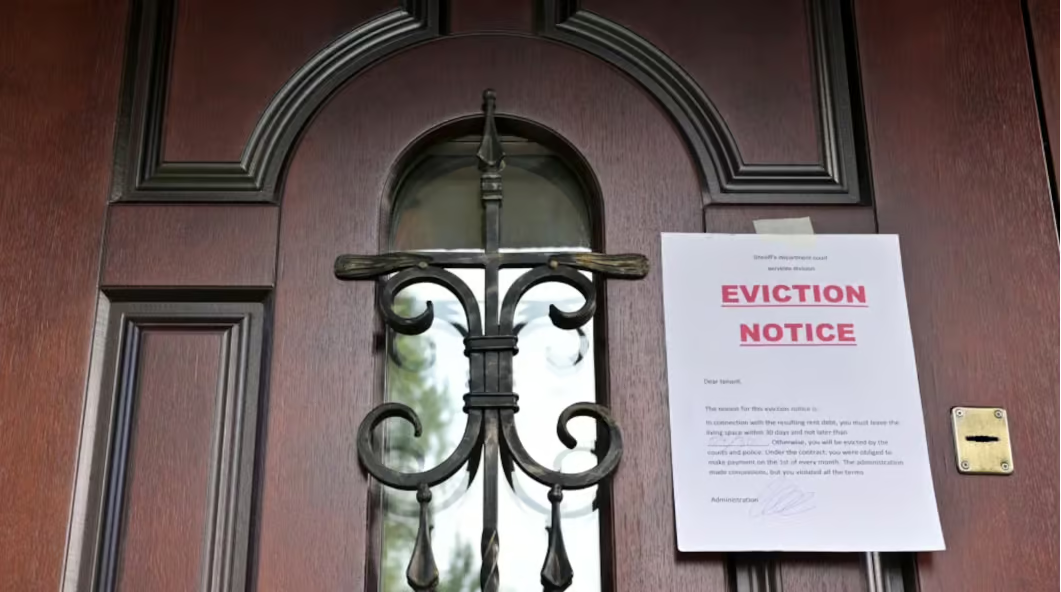
A recent case from British Columbia has attracted attention across Canada after a judge found that family photographs, Amazon deliveries, and other pieces of evidence were not enough on their own to prove a landlord had genuinely moved into a rental property after evicting tenants for personal use. The court ordered a new hearing so that all of the evidence could be properly considered.
Although the case took place in British Columbia, it raises an important question for landlords everywhere:
If you ask a tenant to move out because you or a family member intends to live in the property, how do you demonstrate that your intention was genuine?
For Ontario landlords, this is especially relevant because personal-use evictions under an N12 Notice require a genuine, good-faith intention to occupy the property.
First, This Was a B.C. Case
It’s important not to confuse the laws between provinces.
The recent news involved British Columbia’s Residential Tenancy Branch and B.C. legislation—not Ontario’s Landlord and Tenant Board (LTB).
That means the legal procedures are different.
However, the underlying lesson is similar:
When a landlord says they are moving into a property, evidence matters.
What Is an N12 Notice in Ontario?
In Ontario, an N12 Notice may be used when:
- The landlord intends to move into the rental unit;
- An eligible close family member intends to move in; or
- A purchaser (or the purchaser’s eligible family member) intends to occupy the property.
The law requires that this intention be made in good faith. Ontario courts have confirmed that the focus is whether there was a genuine intention to occupy the property when the notice was served.
Simply wanting the tenant to leave so the unit can later be rented for a higher price is not a proper reason to serve an N12.
What Does “Good Faith” Really Mean?
Many landlords assume that if they eventually stay at the property for a short period, that is enough.
It isn’t always that simple.
The LTB looks at the overall circumstances surrounding the eviction.
Questions may include:
- Was there a genuine intention to live there?
- Did the landlord actually move in?
- Was the property used as a primary residence?
- Did later actions contradict the original reason for serving the notice?
Every case depends on its own facts.
Are Photos or Deliveries Enough?
The recent B.C. case reminds landlords that one or two pieces of evidence rarely tell the whole story.
A few family photos, online shopping deliveries, or changing a mailing address may support a landlord’s position, but they may not, by themselves, establish that the property was genuinely occupied.
Instead, decision-makers often consider the overall pattern of occupancy, rather than relying on one document or photograph.
What Kind of Records Should Ontario Landlords Keep?
If you serve an N12 because you genuinely intend to live in the property, it is wise to keep clear records of your occupancy.
Examples may include:
- Utility accounts connected to the property
- Government identification showing the address
- Home insurance updates
- Moving records
- Everyday evidence that the property became your primary residence
No single document automatically proves good faith.
Instead, consistent evidence that supports your stated intention is generally more persuasive than one isolated item.
Why Good Faith Matters
Ontario tenants who believe they were asked to leave in bad faith may have legal remedies available through the LTB.
For that reason, landlords should never treat an N12 as a shortcut to remove a tenant.
An N12 should only be used when the landlord—or an eligible family member or purchaser—truly intends to occupy the property in accordance with Ontario’s Residential Tenancies Act.
Serving an N12 without a genuine reason can create significant legal and financial risks.
Common Mistakes Landlords Make
Some of the most common mistakes include:
- Serving an N12 before deciding whether they actually want to move in.
- Assuming a short visit counts as occupancy.
- Keeping little or no documentation.
- Thinking an N12 is simply a faster way to end a tenancy.
These misunderstandings can create problems if the landlord later needs to explain their actions before the LTB.
Practical Tips Before Serving an N12
Before serving an N12, ask yourself:
- Do I genuinely intend to live in the property?
- Can I reasonably support that intention if questions arise later?
- Am I following the correct legal process?
If the answer to any of these questions is uncertain, it’s worth seeking professional guidance before moving forward.
Taking time to follow the proper process is often much easier than defending a dispute afterward.
Topromanage’s Perspective
An N12 is one of the most misunderstood notices in Ontario.
Many landlords focus on serving the notice, but forget that the entire process may later be examined if the eviction is challenged.
Good property management isn’t just about using the correct form—it’s about ensuring the reason for the notice is genuine, following the proper legal process, and maintaining clear records throughout.
The recent B.C. case serves as a useful reminder that evidence is rarely judged in isolation. A consistent, well-documented record is far stronger than relying on a few photographs or deliveries after the fact.
Final Thoughts
While this case was decided under British Columbia law, the message applies broadly:
If a landlord asks a tenant to leave because they genuinely intend to move into the property, they should be prepared to demonstrate that intention with credible and consistent evidence if questions arise later.
For Ontario landlords, an N12 should never be viewed as a shortcut. Used properly, it protects legitimate owner occupancy. Used improperly, it can result in lengthy disputes and significant consequences.
Following the correct legal process—and keeping thorough documentation from the beginning—is one of the best ways to protect both your investment and your rights.
Source: CTV News

The Topromanage Experience
Discover decades of industry expertise that covers all of the GTA and Southern Ontario.



Scan A QR Code to Connect With Us
WeChat
WhatsApp