
July 24, 2026 | Blog
City Orders Landlord to Clean Up Encampment Debris: Who Is Responsible When It Happens on Private Property?
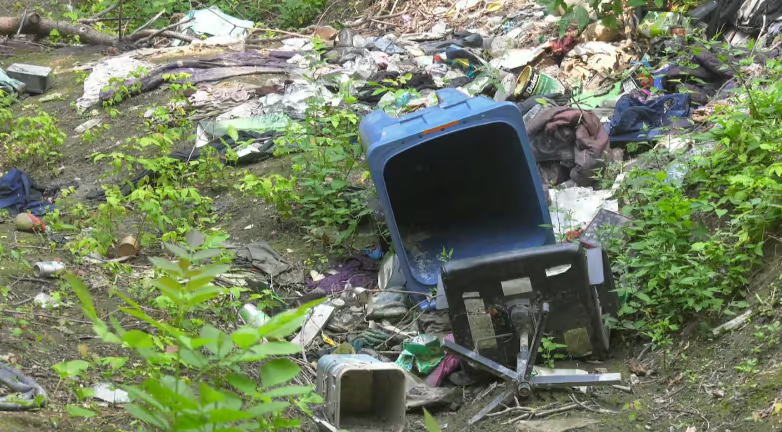
A recent Winnipeg news report described a property manager who was frustrated after the city ordered him to remove debris associated with an encampment behind one of his buildings. The encampment had reportedly existed around the property for some time, and the owner argued that the situation involved broader homelessness, public safety and municipal-service issues beyond a landlord’s control.
However, once garbage, discarded belongings or hazardous materials were located on private property, responsibility for restoring the site could still fall on the property owner.
Although the case occurred in Manitoba and local laws differ, it raises an important question for landlords in Toronto and across the GTA:
What happens when an unauthorized encampment, repeated trespassing or dumped debris appears on private rental property?
The answer can be frustrating. A property owner may be the victim of unauthorized activity and still have obligations to keep the property safe, clean and compliant with municipal standards.
Why Was the Property Owner So Frustrated?
From a landlord’s perspective, the situation can seem unfair.
The owner may not have:
- Invited anyone onto the property;
- Created the encampment;
- Deposited the garbage;
- Caused the underlying housing crisis;
- Had the authority or resources to safely remove people;
- Received timely assistance after reporting the issue.
Yet once the condition affects private land, the city may direct its property-maintenance concerns to the registered owner or manager.
Municipal officers generally focus on the condition of the property—not necessarily on who originally caused it.
This can leave landlords caught between two difficult realities:
- They should not attempt a dangerous or confrontational removal themselves.
- They may still face cleanup orders, expenses or deadlines if the site deteriorates.
Could the Same Thing Happen in Toronto?
The exact rules and procedures depend on the municipality, but Toronto has a specific process for encampments located on private property.
The City of Toronto’s encampment protocol says that when an encampment is identified on private land, the Encampment Office can notify Municipal Licensing and Standards to assess the situation and issue any necessary notices to the property owner. The owner may request outreach assistance through 311 so that Streets to Homes staff can connect with the people at the site.
This distinction is important:
- Outreach teams may assist people experiencing homelessness and offer available services.
- Municipal enforcement staff may examine property-standard, waste or safety concerns.
- The property owner may still be expected to secure, maintain or clean the private land.
- Police or emergency services may become involved where there is an immediate safety or criminal concern.
Calling the city does not automatically mean municipal staff will perform and pay for every part of the cleanup.
Does Private Property Mean the Landlord Can Remove Everything Immediately?
Not necessarily.
A landlord should avoid treating the situation as an ordinary garbage-removal job while people are still occupying the site.
Depending on the circumstances, the issue may involve:
- People who are currently present;
- Personal belongings;
- Possible hazardous waste;
- Fire risks;
- Sharps or unknown substances;
- Animals;
- Mental-health or medical emergencies;
- Disputes over whether the area is public or private;
- Shared property lines or municipal rights-of-way.
Removing belongings without proper direction can create safety, legal and reputational risks.
Property owners should first confirm:
- Where the legal property line is;
- Whether anyone is currently occupying the area;
- Which municipal department is handling the report;
- Whether police or outreach assistance is required;
- What the city expects the owner to do;
- Whether a professional remediation company is needed.
What Should a GTA Landlord Do First?
1. Confirm Whether the Area Is Actually Private Property
The affected space may appear to belong to the rental building but could actually be:
- A public laneway;
- A road allowance;
- A utility easement;
- Municipal land;
- A shared access route;
- Land belonging to a neighbouring property.
Review the survey, site plan, condominium documents or other reliable records before accepting responsibility for an area that may not belong to the property.
Take clear photographs showing where the issue is located in relation to fences, buildings and boundaries.
2. Document the Condition Without Creating Conflict
Record:
- The date and time the issue was observed;
- Photographs taken from a safe distance;
- Approximate location;
- Visible waste or property damage;
- Whether access routes are blocked;
- Whether tenants have submitted complaints;
- Any previous reports made to the city;
- Service-request and incident numbers;
- Communications with neighbouring owners.
Do not photograph people closely or confront them merely to collect evidence.
The purpose is to document the property condition, not to escalate the situation.
3. Contact the Appropriate Municipal Service
In Toronto, property owners can contact 311 for encampment outreach and concerns involving waste, litter, private-property conditions or illegal dumping. The city advises contacting 311 when someone living outdoors may need outreach support.
When submitting the report, explain clearly:
- That the concern is on or beside private property;
- Whether people are currently present;
- Whether the location affects tenants or access;
- Whether there are visible fire, health or safety risks;
- Whether the owner has already received a municipal notice;
- Whether outreach assistance is being requested.
Ask for a service-request number and keep it in the property file.
4. Use Emergency Services Only for Immediate Danger
A landlord should distinguish between an ongoing property concern and an emergency.
Emergency assistance may be appropriate when there is an immediate risk such as:
- Fire;
- Violence;
- Serious injury;
- A medical emergency;
- An active break-in;
- An immediate threat to residents.
An encampment’s presence alone should not automatically be treated as an emergency.
Using the correct service helps ensure that outreach, bylaw, police and emergency resources are directed appropriately.
5. Notify the Property Insurer
Depending on the circumstances, the owner should consider notifying the insurance broker or insurer.
Issues to discuss may include:
- Property damage;
- Fire exposure;
- Vandalism;
- Liability concerns;
- Environmental or hazardous-material cleanup;
- Additional security measures;
- Coverage requirements for a vacant or partially vacant building.
Do not assume cleanup, lost rent or security expenses are covered.
Ask what documentation the insurer requires before work begins.
Why Landlords Should Not Attempt a Confrontational Removal
An owner may feel pressured to “solve the problem” immediately, especially after tenant complaints or a municipal notice.
But confronting people directly can create unnecessary danger.
Property managers and landlords are generally not trained to handle:
- Crisis intervention;
- Mental-health emergencies;
- Hazardous-material exposure;
- Personal-property disputes;
- Violence or unpredictable behaviour;
- Complex outreach needs.
The safer approach is to coordinate with the municipality, outreach providers, police when legally appropriate and qualified cleanup professionals.
Property protection is important, but it should not come at the expense of personal safety or humane treatment.
What Happens After the Site Is Vacated?
Once people have left and the owner has confirmation that cleanup can proceed, the property may need more than an ordinary garbage pickup.
The site should be assessed for:
- Broken glass;
- Needles or sharps;
- Human or animal waste;
- Contaminated bedding;
- Flammable materials;
- Pest activity;
- Damage to fences or doors;
- Graffiti;
- Fire damage;
- Blocked drains;
- Damage to landscaping or exterior lighting.
Do not direct an untrained employee, superintendent or tenant to handle unknown hazardous material.
A specialized cleanup or remediation contractor may be necessary.
Before authorizing the work, obtain:
- Written scope of work;
- Photographs;
- Cost estimate;
- Insurance confirmation;
- Disposal plan;
- Completion report;
- Invoices and receipts.
These records may be relevant to insurance, municipal compliance or future legal advice.
Tenant Safety Must Also Be Considered
When an encampment or repeated unauthorized activity occurs near an occupied rental building, landlords should assess its effect on current residents.
Possible concerns include:
- Blocked entrances;
- Damage to locks or gates;
- Fire routes becoming obstructed;
- Debris in common areas;
- Exterior lighting failures;
- Tenants feeling unsafe;
- Noise or repeated disturbances;
- Access to parking or garbage areas;
- Children or pets entering a contaminated area.
Landlords should communicate carefully.
Avoid messages that stereotype or dehumanize people experiencing homelessness. Instead, provide factual updates such as:
- The concern has been reported;
- The owner is cooperating with the appropriate authorities;
- Residents should avoid a specific area temporarily;
- Emergency exits must remain clear;
- Tenants should report new safety concerns promptly.
Do not disclose personal information or make unsupported accusations about individuals at the site.
Can a Landlord Be Responsible for Injuries on the Property?
Ontario’s Occupiers’ Liability Act generally requires an occupier to take reasonable care, based on the circumstances, to see that people entering the premises are reasonably safe. How that duty applies depends heavily on the facts.
For landlords, this is another reason not to ignore a known hazardous condition.
Once the owner becomes aware of:
- Dangerous debris;
- An unsecured vacant area;
- Broken fencing;
- Fire hazards;
- Poor lighting;
- Unsafe access;
- Contaminated materials,
the owner should document the concern and take reasonable steps to respond.
Reasonable action does not necessarily mean personally entering an unsafe site. It may mean contacting authorities, restricting access where lawful, posting appropriate warnings, arranging professional assessment and following municipal instructions.
Legal advice may be necessary where the risk is significant.
Can the Owner Use Trespass Laws?
Ontario’s Trespass to Property Act applies to many forms of private property and establishes rules concerning unauthorized entry and remaining on premises after being directed to leave.
However, landlords should not assume that reading the legislation gives them a simple removal procedure.
Before relying on trespass law, consider:
- Whether the owner or manager is legally the occupier;
- Whether proper notice has been provided;
- Whether people are still present;
- Whether personal belongings remain;
- Whether police assistance is available or appropriate;
- Whether another legal process applies;
- Whether the location is partly public property.
A lawyer or licensed paralegal can provide advice based on the specific property and situation.
How Can Landlords Reduce the Risk of Recurrence?
After cleanup, prevention becomes important.
Depending on the property, reasonable measures may include:
- Repairing fences and gates;
- Securing vacant structures;
- Improving exterior lighting;
- Locking utility and storage areas;
- Removing hidden areas created by overgrown landscaping;
- Posting appropriate private-property notices;
- Scheduling regular site inspections;
- Responding promptly to illegal dumping;
- Coordinating with adjacent owners;
- Maintaining visible property-management contact information;
- Reviewing camera use for privacy compliance;
- Hiring licensed security services where appropriate.
The goal should not be to create a hostile environment. It is to keep access controlled, protect residents and identify problems before they grow.
Vacant Properties Require Extra Attention
A vacant or partially occupied building may face greater exposure to:
- Unauthorized entry;
- Dumping;
- Property damage;
- Fires;
- Water damage;
- Theft of building materials;
- Insurance issues;
- Municipal orders.
Owners should confirm the insurer’s vacancy requirements and create a documented inspection schedule.
A property that appears abandoned can quickly attract repeated activity. Regular inspections, lighting, maintenance and prompt repairs show that the site is actively managed.
The Larger Issue Cannot Be Solved by One Landlord
Encampments are not simply a property-maintenance problem.
They are connected to broader issues involving:
- Housing affordability;
- Shelter availability;
- Mental-health supports;
- Health care;
- Income insecurity;
- Addiction services;
- Community safety;
- Supportive housing.
Municipalities and provinces have outreach and housing programs because private property owners cannot solve these issues alone. Manitoba’s housing strategy, for example, has included funding for transitional housing, navigation services, rental supports and wraparound services for people leaving encampments.
At the same time, owners cannot simply leave dangerous debris or unsafe conditions indefinitely because the underlying cause is beyond their control.
Effective responses require cooperation among property owners, municipalities, outreach organizations, emergency services and housing providers.
Topromanage’s Perspective
The Winnipeg case highlights a difficult reality of property ownership:
Landlords can be required to respond to a problem they did not create.
When an encampment, unauthorized occupation or significant dumping appears on private land, waiting for the issue to disappear can allow it to become more expensive and dangerous.
A strong property-management response should include:
- Prompt documentation;
- Confirmation of property boundaries;
- Municipal reporting;
- Outreach coordination;
- Tenant communication;
- Insurance notification;
- Professional cleanup;
- Site-security improvements;
- Complete records of every action taken.
At Topromanage, we believe these situations should be handled calmly, professionally and humanely.
Protecting the property and its residents is important, but so is recognizing that people experiencing homelessness may need outreach and housing support—not an unsafe confrontation with a landlord or building employee.
Final Thoughts
The Winnipeg property manager’s frustration is understandable.
He reportedly believed the city was placing the cost and responsibility for a broader community problem onto a private owner. At the same time, municipalities may still require private properties to comply with cleanliness and safety standards.
For GTA landlords, the lesson is not to wait until a cleanup order arrives.
When unauthorized occupation, debris or safety concerns appear:
- Document the condition.
- Confirm the property boundary.
- Contact the appropriate municipal service.
- Request outreach support when people are present.
- Avoid direct confrontation.
- Notify the insurer when necessary.
- Use qualified cleanup professionals.
- Improve the site to reduce recurrence.
- Keep tenants informed without spreading rumours.
- Obtain legal advice when the situation is unclear.
Property ownership does not give a landlord control over every event that happens nearby. But active, documented management can reduce risk, protect residents and prevent a difficult situation from becoming an even larger one.
Source: CTV News

The Topromanage Experience
Discover decades of industry expertise that covers all of the GTA and Southern Ontario.



Scan A QR Code to Connect With Us
WeChat
WhatsApp